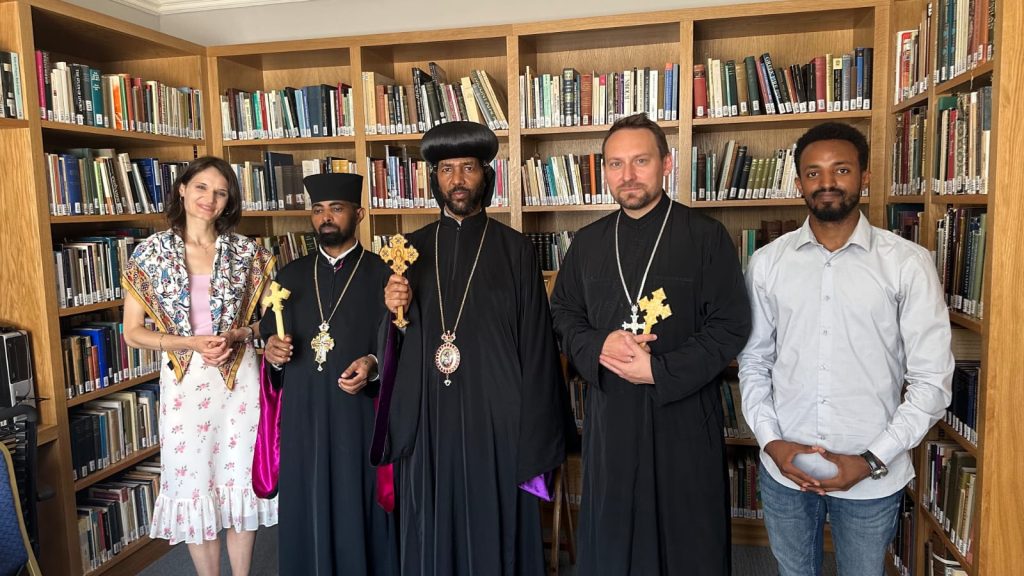
On 10 July 2026, IDVRM Founding Executive Director, Dr Romina Istratii, hosted in Cambridge His Eminence Abune Ephrem, Archbishop overseeing pastoral care for the Tigrayan Orthodox Tewahedo community in the United Kingdom and all of Europe. The meeting took place at the Institute of Orthodox Christian Studies (IOCS) presided by the Principal, and was part of IDVRM’s ongoing effort to promote transboundary collaboration with religious leaders to build better responses to family violence and conflict-related sexual violence.
The meeting centred on how to support Tigrayan communities at home and in the diaspora amidst severe humanitarian needs, political instability and conflict-related trauma, as well as crucially exploring ways to respond to the needs of sexual violence survivors, addressing spiritual trauma, stigma and holistic re-integration in community life.
Below, we present the interview between Dr Istratii and His Eminence which took place during the recent visit. The interview also serves as an opportunity to re-launch our campaign in support of survivors of conflict-related sexual violence. Our goal is to raise £5,000 to develop a survivor-centred, evidence-based and culturally informed response in partnership with the religious leadership and community organisations in the region. Read more below to donate.
Dr Romina Istratii: Dear Abune Ephrem, could you kindly introduce yourself and share an overview of your current activities and responsibilities in the United Kingdom?
His Eminence Abune Ephrem: My name is Abba Ephrem and I am assigned as Archbishop for the Diocese of the Tigrayan Orthodox Tewahedo Church (TOTC) across all of Europe. My ministry encompasses the critical dual role of spiritual oversight and administrative governance. My responsibility extends far beyond the United Kingdom; I am tasked with providing consistent spiritual guidance, administrative oversight and strategic direction to our entire European jurisdiction, ensuring that our parishes across the continent function as unified beacons of hope and spiritual communion for the diaspora.
In the aspects of Spiritual and Administrative Oversight: I provide leadership for the entire European Diocese of the TOTC, ensuring that our spiritual traditions are maintained while managing the complex administrative requirements of a transboundary church structure.
In the aspects of expanding Diplomatic Reach: beyond our internal mission, I engage in essential diplomatic work, representing the voice of our community in Tigray and abroad and advocating for the needs of our people and searching for any diplomatic and financial supports, as we all know that the Tigray people survived a tragic and devastating war, were neglected by the then-church leadership and many people lost their life – without forgetting the lost dreams, disabilities, hopes and gender-based violence (GBV).
In the aspects of Strategic Vision for Healing: as a diocese we are spearheading a strategic plan that shifts our focus from reactive ministry to proactive, systemic support. This plan is specifically designed to form a new structure in the diaspora, help and navigate ways of reconstruction, reform the destructions that have happened, address the healing and empowerment of GBV survivors and war-induced harms, as well as those suffering from the primary and secondary trauma of conflict, ensuring these efforts are implemented accordingly across all our respective areas in Tigray and Europe.
And to do all the above activities our work is guided by the principle of servanthood, as described in 1 Peter 5:2–3, which mandates that we “tend the flock of God that is in your charge, exercising oversight… but being examples to the flock”. By integrating these spiritual, administrative and diplomatic duties, we strive to ensure that the Diocese of TOTC in Europe not only aims to preserve our sacred traditions but also works actively to address the urgent, contemporary needs of our wounded and marginalised community members across Tigray and the European continent.
RI: Given the recent devastating conflict in Tigray, many in the diaspora have fled severe violence. What would you say are the key pastoral and psychological challenges facing your community today, particularly the primary and secondary trauma you referred to?
AE: Our community is currently navigating a profound landscape of suffering, where the distance from our homeland does not equate to an absence of pain. We are witnessing a complex interplay of primary trauma, experienced by those who fled direct violence, and secondary trauma of those who carry the agonising burden of having witnessed the destruction of their families, culture and history from Tigray.
Within the context of responding to pastoral complexities, the diaspora faces a unique crisis where grief, displacement and the struggle to maintain cultural identity collide, often leaving individuals feeling spiritually and emotionally adrift. Many – almost everyone – in the diaspora lost their relatives, have been unable to know the whereabouts of their family, have migrated, or were raped and suffered all the mishappens of the war. And still the people carry with them that primary and secondary trauma, as trauma needs time to heal. Having said these things, the news that we hear from Tigray right now is bringing a flashback of the tragic war and the retraumatisation of the people. This brings an additional challenge on the pastoral work of healing and another psychological burden.
Though we trust in God that He will give us the strength to address the challenges, we do have systemic resource challenges. That is, our current ability to address these needs is severely limited by a critical lack of well-trained human resources, deep-seated financial scarcity and a concerning absence of established, supportive aid networks that could facilitate long-term pastoral healing and psychosocial recovery.
As clearly stated in our strategic plan we tend to foster spaces for communal mourning, grounding our people in the understanding that their pain is seen by God. As it is written in Psalm 34:18, “The Lord is near to the broken-hearted and saves the crushed in spirit”. We believe that our pastoral duty is to facilitate this divine nearness, even when human support structures remain fragile.
Watch Dr Romina Istratii and His Eminence speak in Tigrigna about the Tigrayan community
RI: Thank you for sharing, Abune Ephrem. Given these many challenges, could you say a little more on how you and the Church are currently supporting the community and where you see the most critical unmet needs?
AE: As Archbishop, I view our Diocese not merely as a formal institution, but as a hospital for the soul. Yet, I must be honest: the scale of the trauma we face – a trauma fuelled by systematic violence – vastly outstrips our current, limited capacities.
When we look at our current pastoral and holistic support, we are working to weave together traditional pastoral care with urgent social support. Our parishes are intended to be common treasuries, as St. Basil the Great envisioned for his Basiliad, where we pool our resources to provide immediate assistance to the destitute, offering both a space for communal lament and a refuge from isolation.
It is known that the depth of the crisis is beyond words. The humanitarian data is stark and underscores the necessity of our mission. Reports indicate that over 80 percent of health facilities in the region, Tigray, were damaged or destroyed during the conflict, leaving survivors with virtually no access to the medical or psychological care they desperately need. Furthermore, research suggests that nearly all sexual violence survivors have been deprived of essential medical and psychosocial support, leaving them to navigate their trauma in total silence.
Our community is currently navigating a profound landscape of suffering, where the distance from our homeland does not equate to an absence of pain.
Due to the devastating effect of the war there are critical unmet needs. Our most significant gaps are structural: we face a severe shortage of trained, trauma-informed human resources, persistent financial scarcity and the absence of institutionalised networks that can provide long-term, sustainable healing.
To tackle the issue, our planned strategic approach and mandate is to transition the Diocese from reactive relief to proactive, strategic empowerment. We are not merely seeking to manage the symptoms of this tragedy; we are committed to building a transboundary, trauma-sensitive infrastructure that empowers our people to reclaim their dignity. We are actively calling for global partners who recognise that the spiritual recovery of our survivors is highly linked to the provision of tangible, professional, medical and generally holistic support.
RI: As you mentioned, the trauma facing survivors is multi-dimensional. Direct testimonials suggest also spiritual trauma and concerns interfering with coping and healing. In your daily ministry, have you encountered specific spiritual anxieties such as survivors feeling unable to pray, questioning their relationship with God or feeling spiritually exiled?
AE: Yes, and it is a reality that breaks my heart. To speak frankly, the scale of this trauma is deep, vast and unprecedented. Reports from the Commission of Inquiry on Tigray Genocide (CITG) and other credible sources indicate that over 150,000 victims were subjected to rape, with the vast majority of victims and survivors being denied essential medical or psychosocial support. In this context, we encounter many who suffer from a profound sense of spiritual exile, feeling that their bodies, and consequently their spirits, have been contaminated, leaving them paralysed in prayer or unable to approach the Holy Mysteries due to misplaced feelings of shame and guilt.
During my visits to both urban and rural areas of the region, I have met with many survivors. I have witnessed firsthand how the weaponisation of sexual violence, often used with genocidal intent, has led many survivors to question God’s presence or to feel permanently alienated from the Church. We deeply appreciate the work and support of scholars, like that of yours, whose research and visits to Tigray can bring much-needed attention to these spiritual anxieties; the engagement – with the grace of God – will serve as a vital foundation for our shared commitment to healing.
While our Church has historically lacked a fully developed, centralised manual for addressing every dimension of this complex trauma, we are taking decisive action. The Holy Synod, of which I am a member, has taken a definitive and uncompromising stance: any priest found to abandon, stigmatise or restrict a survivor of GBV from participating in the sacraments shall be excommunicated from his priesthood.
Our pastoral ministry is now focused on dismantling the lie that survivors are unclean. We teach that Christ, the Wounded Healer, does not stand at a distance from this suffering; He is present within it. Psalm 34:18 reminds us that the Lord is near to the broken-hearted, and our role is to act as a bridge, ensuring the Church is a sanctuary of grace rather than a source of further judgment. We invite continued collaboration to translate this pastoral vision into the sustainable, trauma-informed support our people so desperately need.
RI: Beyond supporting projects like the one we sought your blessing for during my last visit in Tigray in 2025, in the context of which we propose to develop a theologically informed spiritual care framework working with Tigrayan theologians to respond and reverse harmful community misconceptions and survivor trauma, what other systemic steps can migrant churches take to reform these practices and ensure the Church is a sanctuary of healing for all?
AE: I firmly believe that we must have the courage to acknowledge that the silence or judgment survivors sometimes encounter within our community is a profound failure of our pastoral duty. When a survivor is met with stigma, we are not just failing a person; we are failing in accurately teaching the message of the Gospel itself.
And we need to have systemic reform and accountability. As a diocese we are taking decisive administrative action to ensure our churches are true sanctuaries.. We view this as a necessary, non-negotiable step to restore the sanctity of our pastoral care.
Side by side, we plan on equipping the shepherd on a proper way of pastoral responsibility. We plan to build a centralised training resource with other helping stakeholders and partners. It is my firm belief that a shepherd cannot guide the wounded if they do not understand the nature of the wound. We want our clergy to move away from outdated, harmful cultural norms and toward a model of radical compassion, where the dignity of the survivor is placed above all else, though we can’t immerse fully due to lack of trained human resource and finance.
We are working to replace the culture of shame with a culture of justice. As St. John Chrysostom taught, the glory of the Church is not in its walls but in its defence of the most vulnerable among us. We are publicly teaching that sexual violence is a heinous crime against the person, never a stain upon the survivor.
And we want our ministry to be an evidence-based ministry. We recognise that the majority of survivors currently lack access to even basic psychosocial support. By professionalising our referral pathways and ensuring that every parish priest knows how to connect a survivor to medical and psychological experts, we want to transform our Church from a place of potential isolation into a frontline of healing and support.
RI: Thank you for your commitment to serve those affected by conflict. To end this interview, what is the most critical message you wish to convey to Orthodox Christians and the wider global Christian community regarding the situation in Tigray? How can they best help both the communities in Tigray and those in migration?
AE: My message to the global Christian community is simple: “When one member suffers, all suffer together” (1 Corinthians 12:26). We are calling for a transboundary solidarity that goes beyond mere words to a commitment to the survival, dignity and healing of our people.
We are facing a catastrophe of historic proportions. With hundreds of thousands of victims of sexual violence and most survivors left without medical or psychosocial support, this is a crisis that demands urgent global attention. The damage or destruction of more than 80% of our health infrastructure, and more than one million internally displaced people during the conflict, has left our people in a state of existential emergency and we cannot remain silent while our brothers and sisters are stripped of their dignity.
We ask for solidarity. We are ‘one body in Christ’. When our survivors in Tigray or those scattered in the diaspora suffer, the entire global Church shares in that suffering.
We would like to call for a sustainable partnership. We are not merely asking for charity or temporary relief. We need sustainable investment in our diocesan infrastructure, professional training for our clergy, the creation of trauma-informed networks that can bridge the gap between our pastoral care and the professional, medical and psychological services our people urgently require and financial supports where we can empower and support the survivors and work for the rebuilding and reformation of Tigray.
We also call for action over silence. We ask the global community to use their influence and resources to advocate for truth and justice. We need you to help us build a common treasury of support, not just to alleviate temporary pain, but to empower our survivors to reclaim their lives, their families and their future.
Join Our £5,000 Matching Campaign for Survivors in Tigray
The conversation with Abune Ephrem reminds us that healing after conflict is not only a political or humanitarian responsibility—it is also a moral and spiritual one. Survivors of conflict-related sexual violence continue to carry profound psychological, social and spiritual wounds, while many local organisations remain under-resourced in their efforts to accompany them.
To help sustain our work with local partners and advance culturally and theologically informed responses for survivors, the Institute of Domestic Violence, Religion & Migration (IDVRM) is re-activating our £5,000 fundraising campaign.
Our Founding Executive Director, Dr Romina Istratii, has pledged to personally contribute up to £1,500 in matched funding. Every donation made by members of our community will be matched by Dr Istratii up to the committed maximum amount.
This means that your gift has twice the impact until the matching fund is fully allocated.
Whether you are able to give £5 or £100, your generosity will help us reach our £5,000 target and support survivor-centred, evidence-based and culturally grounded initiatives in Tigray.
If the interview has moved you, please consider becoming part of this collective effort. Together, we can send a clear message that survivors have not been forgotten, and that faith-informed research and humanitarian commitments can work hand in hand to support healing and restoration.
Donate today and help us unlock the full matching pledge.
Acknowledgements: The current essay was edited and prepared for publication by IDVRM Chief Editor, Marley Markham. We are grateful for the video and photo material provided by the delegation of Abune Ephrem, including Deacon Nathaniel.
Disclaimer: IDVRM aims to serve as a platform that researchers internationally, especially in the non-western world, can use to disseminate their research. We do our best to ensure that authors who publish with us have conducted their research following the highest ethical standards, with decolonial reflexivity and principles of least harm to participants in mind. We do not require authors to submit ethical documentation, but we ask our authors to provide sufficient information about ethical procedures in their submissions. It is beyond the capacity of IDVRM to verify this information. Authors should be reached directly to respond to questions regarding their research.
Opinions expressed by authors contributing to our blog are those solely of the authors and do not necessarily represent the position of IDVRM, its Director or other team members. IDVRM is comprised of diverse individuals who are encouraged to share their experiences and opinions openly with recognition that other team members may have different experiences and positions. IDVRM does not claim to represent any one community and we understand that belonging to a specific group does not entitle any one of us to speak for all.
AI Use: IDVRM may use AI tools for editing and proofreading purposes to improve language, syntax and grammar. Essays must be the original work of the author.