Transforming disagreement into opportunities for mutual understanding, critical reflection and collaborative action
IDVRM’s Epistemology of Disagreement framework is an intellectual and practice-informed approach proposed by Dr Romina Istratii in her monograph, Coloniality in Gender and Development: Proposing an Epistemology of Disagreement (Routledge, 2026). It seeks to help individuals and groups navigate profound differences in worldviews, values and ways of making meaning, and work together towards addressing shared societal challenges.
Developed through years of anthropological research, theoretical inquiry and practical experimentation across Africa and Europe, and applied and refined in the context of Project dldl/ድልድል, the framework challenges the assumption that disagreement necessarily reflects a failure of communication or understanding.
It recognises that people may approach the same issue from fundamentally different assumptions about what constitutes knowledge, what matters morally and how problems should be understood and addressed. It is especially inspired by differences across religious and secular worldviews and the challenges of fostering collaborative responses to gender-based violence among faith actors, women’s groups and state agencies.
The approach was applied to achieve religious-secular actor collaboration through Project dldl/ድልድል, working with nine partner organisations in Ethiopia and the UK. It also partly informed a collective intelligence deliberative approach for promoting multidisciplinary climate responses among UK research innovators as part of a collaborative grant with Dr Maru Mormina.
At IDVRM, we seek to translate this framework into practical approaches that help communities, organisations and institutions engage constructively across differences, without seeking to erase them or allowing them to become sources of domination, exclusion or violence.
What is it?
A framework for understanding and navigating differences in worldviews, values and meaning making through knowledge and experience sharing, self-reflexivity and critical deliberation.
It starts from the recognition that meaningful disagreement is not necessarily something to overcome. When approached constructively, it can become an opportunity for mutual learning, deeper understanding and more equitable forms of collaboration.
Rather than presuming that one perspective should provide the starting point for understanding an issue, the framework encourages people to examine the assumptions underpinning their own positions and those of others.
It offers an alternative both to the imposition of dominant perspectives and to forms of relativism that place all positions beyond meaningful critical examination.
It seeks to create conditions in which differences can be genuinely acknowledged, critically explored and negotiated without requiring consensus.
How does it work?
The framework brings together positionality analysis, critical thinking, epistemic and cultural self-reflexivity, contextualisation, Socratic dialectics and active listening.
Through facilitated deliberation, participants can examine differences, question taken-for-granted assumptions, develop mutual understanding and explore possibilities for collective and collaborative action.
Importantly, the purpose is not necessarily to achieve agreement, but to develop the capacity to remain in disagreement constructively, while recognising and addressing dynamics of exclusion, domination and violence.
How can you use it?

Train with us
Access workshops and tailored training introducing the Epistemology of Disagreement framework and its practical applications. Develop the capacity to recognise underlying differences, facilitate constructive engagement and strengthen collaboration across cultural, religious and other divides.
Organise deliberations
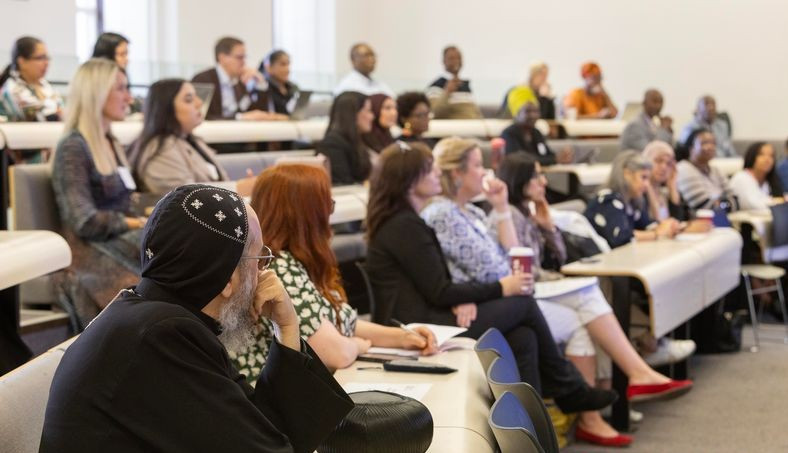
IDVRM supports communities, organisations and local councils to organise facilitated deliberations informed by the framework. We help create spaces where people can explore contested issues, engage with different perspectives and identify possibilities for mutual learning, negotiation and collaborative problem-solving.
Credits: The Epistemology of Disagreement framework draws on established intellectual traditions and practices, and has been developed and proposed in the form we use it by Dr Romina Istratii through her research, theoretical work and applied experimentation. For its scholarly foundations, see Istratii (2026), Coloniality in Gender and Development: Proposing an Epistemology of Disagreement (Routledge).