
Image credits: Pixabay
In this blog, IDVRM Chief Editor Marley Markham reflects on his experience carrying out ethnographically-grounded journalism to suggest a more nuanced and human-centred approach to storytelling for the purpose of impactful advocacy and evidence communication. Drawing from recent experience supporting IDVRM’s training on audience-centred analysis for evidence communication and impact, he outlines the risks of over-simplistic narratives and argues for a combination of ethnographic and journalistic techniques to ensure that the individuals and communities at the heart of our communications have an opportunity to shape how their story is told.
If you work in advocacy or evidence communication, you are probably familiar with the complicated journey from research to effective messaging. You’ve done the research, conducted interviews, methodically mapped stakeholders, identified an opportunity to capture attention. You have paved the way, but somewhere between preparation and product the essence of the message strays from the path.
In September, I supported IDVRM’s Executive Director, Dr Romina Istratii, and regional experts to deliver a tailored training on Audience Analysis for Strategic Advocacy, Policy Influence and Evidence Communication.
For my contribution, I drew on my personal experience as an ethnography-grounded journalist in an effort to identify how we – as communicators and as human beings – can honour the words of our participants from beginning to end while maximising effective messaging to impact audiences.
In the current blog, I reflect on key training messages and why I consider them important for anyone aiming to communicate research or programme findings effectively to generate social impact.
Why lacking ethnographic contextualisation can lead to dehumanisation
Humanising messaging is vital in advocacy, evidence sharing and policy impact. A common challenge that arises in the process of translating research and evidence into audience-specific messages is that multi-layered and nuanced realities can be reduced into dominant, simplistic or over-rehearsed narratives that end up losing their specific audiences.
One example is given by Séverine Autesserre (2012) in the context of conflict-related advocacy in the Democratic Republic of Congo. According to the author, often international NGOs have used an over-rehearsed narrative about the causes of conflict, resulting in a three pronged narrative: Primary cause of violence identified with illegal natural resource exploitation; sexual abuse against women and girls as the main consequence; and reconstructing state authority as the central solution. Evidently, both the explanatory factors and the consequences and solutions have been more nuanced and intersectional than suggested here.
Why are such narratives problematic? After all, one might argue, they are often effective in mobilising support or raising awareness.
The problem, as Autesserre (2012) demonstrates, is that simplified narratives can have unintended and sometimes harmful consequences for the very communities they seek to support. In eastern DRC, the disproportionate international focus on sexual violence had an unintended effect: some armed-group leaders recognised that using or threatening rape could attract international attention, generate pressure on the Congolese government and strengthen their position in negotiations. Sexual violence therefore became, in Autesserre’s analysis, an effective bargaining tool for combatants. Meanwhile, international efforts to extend state authority in the region risked strengthening the coercive capacity of state institutions whose officials and security forces were themselves implicated in human rights abuses. Rather than necessarily improving protection, these interventions could therefore reinforce existing structures of oppression (Autesserre 2012).
In this way, dominant narratives can not only cause harm but also displace the knowledge, perspectives and agency of the communities they claim to represent. Genuine empowerment, by contrast, requires processes in which participants are not merely represented or consulted, but have a meaningful role in shaping both the outcomes and the direction of the work.
For NGOs, the challenge has been to develop messaging that humanises people’s experiences and motivates action without losing sight of the complexities of the situations being communicated. Various strategies have been explored to achieve this, including engaging audiences in ways that encourage action, involving survivors of violence in the design of strategies and communications, aligning messages with the values of intended audiences, and using memorable ‘killer facts’ to capture attention and make an issue resonate (Mayne et al. 2018).
The example from the DRC illustrates how messaging that succeeds in capturing international attention can still have unintended consequences, potentially reinforcing harmful power dynamics and diminishing the agency of the communities it seeks to support. This is an important consideration in advocacy and evidence communication: making a message accessible and compelling should not come at the expense of the human experiences and complexities it seeks to convey.
At IDVRM, we believe that effective communication must balance the need for clear, engaging messaging with a commitment to preserving the human experience, voice and agency of those whose stories and realities are being communicated. This means going beyond simply making people visible or using their experiences to illustrate a wider issue. It requires creating opportunities for them to shape how their experiences are understood, represented and communicated.
Yet an ethnographic approach has not always been explicitly incorporated into communications and messaging. This is something I wanted to address through the recent training, by bringing ethnographic tools into conversation with journalistic aims. My intention was to explore how communicators can engage audiences and make evidence resonate while remaining attentive to the perspectives, experiences and agency of the people at the heart of the story.
Ethnography: where can it take us?
What is ethnography? Officially, ethnography is a form of participatory research in which the researcher hopes to gain a deep qualitative understanding of the realities and worlds that their subjects inhabit (Clifford & Marcus 1986). Unofficially, as Joost Fontein (2013, 57-58) tells us, ethnography “is as much an attitude, or way of reading, seeing and being as it is a bundle of research methods.”
This was a lesson I learned in Cambodia, conducting my first ethnographic fieldwork in completion of my Master’s thesis at SOAS University of London on the topic of violence and memory in the country. I was initially unaware that the interviews and visits that I had earnestly planned would ultimately fall into the shadows of countless ‘accidental’ observations, meetings and moments. Markets became sites of reflection, conversations became interviews, feelings became observations.
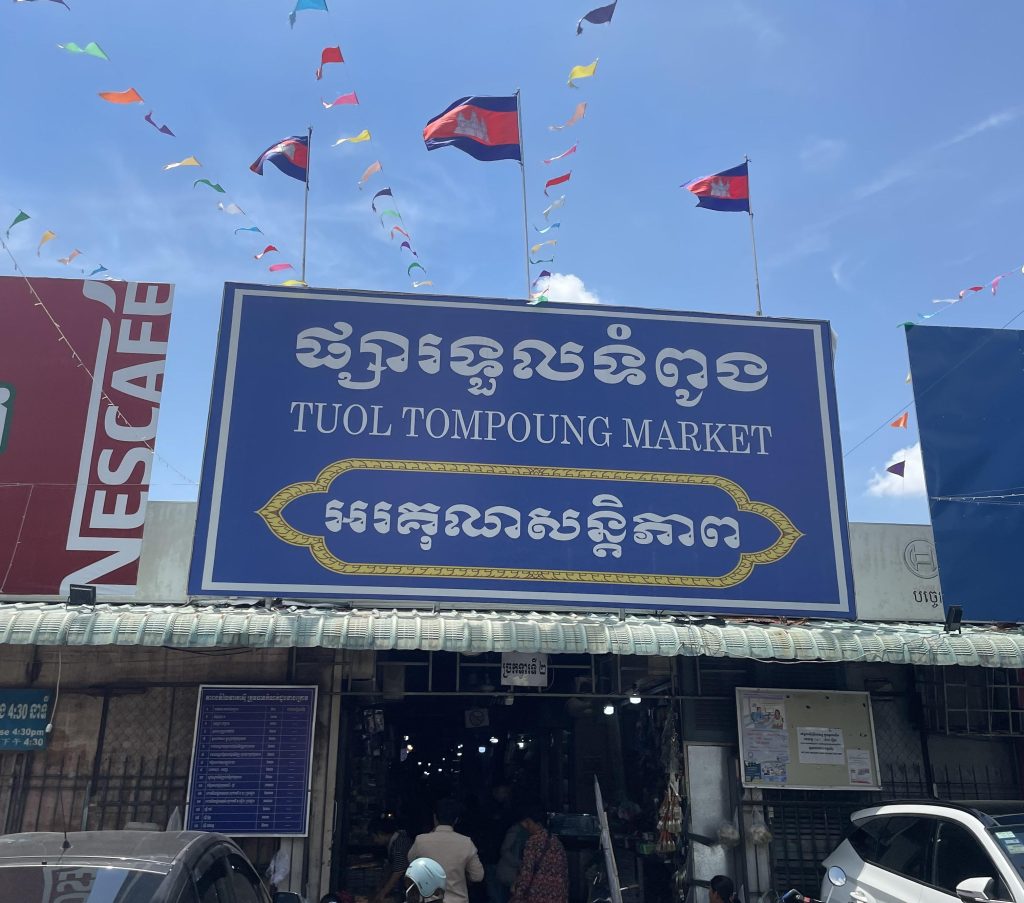
Image: A state-sanctioned sign declaring “Thanks for Peace,” framed by gold, above the entrace to Tuol Tompoung Market, Phnom Penh, Cambodia. Credits: Marley Markham.
But what does all of this tell us about communications and why was it important for the training?
I believe that, ultimately, ethnography allows us to humanise without homogenising. It does this because of four main characteristics:
- It is reflexive: ethnographers are encouraged to consider their own positionality within a field of research, considering the perspective of their participants in doing so.
- It focuses on the subjective: ethnography takes lived experience into consideration, rather than reducing realities into objective facts.
- It is participatory: ethnographic research is based on participation within the field of research, allowing the ethnographer to build trust and a deeper understanding of issues.
- It is critical of simple answers: by way of the above, ethnography rejects conclusions or narratives that reduce complex realities into monolithic categories.
While these characteristics allow us to humanise research and its communication without homogenising diverse experiences, ethnographic work can risk being perceived as inaccessible to an everyday audience. This is where the journalistic approach can contribute.
Journalism: how can we connect?
Journalism is a more familiar discipline than ethnography, which, despite its many strengths, can sometimes feel removed from our audiences’ everyday lives and, perhaps more importantly, their attention spans.
As we know, the truth can at times be complex. And of course, while we want to humanise without homogenising storytelling and communication, sometimes we need to convey acute elements of a story to an audience in a way that is timely and audience-focused.
From experience in working with international teams in reporting on topics like organised crime and engaging in independent journalism in my local neighbourhood, I have learnt the importance of identifying what elements of a story resonate with an audience and when is the most effective moment to tell a story.
During the training, I proposed that journalism has four main characteristics that can complement ethnography:
- It is editorial: journalists are strategic in their delivery and timing, attaching stories to ‘hooks’ such as global news agendas and awareness days.
- It is time-sensitive: journalism is more reactive than ethnography, which can allow it to respond to events or news cycles that our audiences care about.
- It can be highly accessible: whether an explainer article, a podcast or a documentary, journalism is ultimately concerned with making topics engaging and easy to digest.
- It can provide clear answers: while we want to avoid ‘dominant’ overarching narratives, we still need to be able to pull on clear and concise takeaways to appeal to audiences, particularly policymakers.
In our training, I sought to demonstrate that, together, these two disciplines can provide us with an interdisciplinary and refined toolkit combining the best of both worlds.
How reflexivity can help us navigate ethical considerations
Through my experience with ethnography and journalism, I have encountered distinct ethical considerations in working with research participants and interviewees. During my ethnographic fieldwork in Cambodia, the pursuit of a deep qualitative understanding led me to develop close relationships with participants, at times bringing me close to the boundaries of conventional research practice. This was particularly significant given the sensitivity of my research on the Khmer Rouge genocide and my responsibility to protect participants’ privacy, safety and emotional wellbeing.
Journalists, by contrast, may maintain a more distanced relationship with their interviewees, but their wider public reach brings a particular responsibility for how they frame and portray the issues they report on. I encountered this when reporting on organ trafficking and migration in Latin America, a subject shaped by widespread misconceptions and involving potentially traumatic experiences. The ethical implications of journalistic representation are therefore considerable: the way a story is framed can shape public opinion and have lasting consequences for the lives of those portrayed, long after publication.
These considerations are exacerbated in high-risk contexts. In Cambodia, for instance, where participants indicated that there was a degree of political censorship, I had to manage risks of reprisal that my participants could face for opposing the official state narrative. In my work reporting on organised crime, it was important to avoid re-traumatisation and to protect survivors from social stigma or putting them at further risk of community isolation.
To some extent, I took similar precautions in both cases to help protect my participants from adverse effects. For instance, ensuring informed consent and providing the participant with the ability to withdraw throughout the research, anonymising/pseudonymising names to protect identity and maintaining transparency regarding the purpose of the research throughout. But in the field, ethical responsibilities can become clouded by relationships with participants and realities on the ground, making it important to pursue a reflexive and embodied ethics.
As highlighted in a previous IDVRM Evidence Bits issue focused on research with survivors of female genital cutting (FGC), ethical decision-making is an ongoing process which often exceeds textbook guidance and relies on the moral judgement of the researcher. This can be daunting for a researcher, and especially from a practitioner who has not been trained in research ethics. However, I believe that by constantly considering elements such as power dynamics, survivor risks and the consequences for participants, whether in research, programme delivery or communications of their findings, it is possible to maintain the balance between communication and effective messaging and ethical, person-centred practice.
A combined approach
I believe that ethnography and journalism are two estranged relatives with unique personalities, held together by a common DNA: to document the world and the experiences within it.
Ethnography can humanise without homogenising real life experiences, evoking the intricacies and nuances of the world, allowing multiple realities to coexist without collapsing under the weight of an overarching, ‘dominant’ narrative.
Journalism can connect complex truths with diverse audiences, harnessing events and news that our audiences care about and delivering concise and clear answers through those windows of opportunity.
How these are to be combined should be dictated by the user’s needs, context and audiences.
The idea I sought to convey in the training is that these two approaches can be combined to give communicators a dynamic toolkit, grounded in the lived experiences of both participants and audiences. Bringing these two worlds into dialogue is not always straightforward, which is why I believe trainings such as the one we delivered at IDVRM can add immense value, offering a safe and productive space to explore these intersections with the contextual nuance they require.
References
Autesserre, S. (2012). Dangerous Tales: Dominant Narratives on the Congo and Their Unintended Consequences. African Affairs, 111:445, 202-222. https://www.jstor.org/stable/41494485.
Fontein, J. 2013. Doing research: Fieldwork practicalities. In Doing Anthropological Research: A Practical Guide (ed.) N. Konopinski, 37-54. London: Routledge.
Mayne, R., Green, D., Guijt, I., Walsh, M., English, R. & Cairney, P. (2018). Using evidence to influence policy: Oxfam’s experience. Humanities and Social Sciences Communications, 4:122. https://www.nature.com/articles/s41599-018-0176-7.
Discover our training: Contextualised Audience Analysis for Community-Based Research Translation, Advocacy and Policy Impact
Effective research translation, advocacy and policy impact depend not only on the quality of the evidence produced, but on how well research, messages and products are understood, received and used by the audiences they seek to engage or influence.
While stakeholder mapping helps identify relevant actors, audience analysis goes further by examining who an audience is, what shapes their perspectives, behaviours and decisions, and how these factors should inform research, evidence translation, communication and engagement strategies.
By building on the Project dldl/ድልድል Model® Audience-Centred Approach to Problem Analysis and the IDVRM Research Translation Cycle (©Dr Romina Istratii), this practical training introduces a contextualised approach to audience analysis for community-based research translation, advocacy and policy influencing.
About the author

Marley Markham is Chief Editor at the Institute of Domestic Violence, Religion & Migration. With a background in journalism and Master’s degree in Social Anthropology from SOAS University of London, Marley combines ethnographic nuance with editorial clarity to convey impactful stories through the voices of those at their heart. He conducted fieldwork in Cambodia in completion of his Master’s thesis, taking a decolonial and spiritually-informed approach to the topic of ‘intergenerational trauma,’ researching how generations born after catastrophic violence understand their country’s history and how that understanding in turn shapes their imaginations of the future. He has journalistic experience covering topics ranging from human trafficking, geopolitics, culture and identity, always seeking to centre stories around stakeholders.
Disclaimer: IDVRM aims to serve as a platform that researchers internationally, especially in the non-western world, can use to disseminate their research. We do our best to ensure that authors who publish with us have conducted their research following the highest ethical standards, with decolonial reflexivity and principles of least harm to participants in mind. We do not require authors to submit ethical documentation, but we ask our authors to provide sufficient information about ethical procedures in their submissions. It is beyond the capacity of IDVRM to verify this information. Authors should be reached directly to respond to questions regarding their research.
Opinions expressed by authors contributing to our blog are those solely of the authors and do not necessarily represent the position of IDVRM, its Director or other team members. IDVRM is comprised of diverse individuals who are encouraged to share their experiences and opinions openly with recognition that other team members may have different experiences and positions. IDVRM does not claim to represent any one community and we understand that belonging to a specific group does not entitle any one of us to speak for all.