Translated research-based creative outputs into social and cultural value at community level
Having emerged as an independent spinout enterprise from the university-based Project dldl/ድልድል®, during its first year of existence, IDVRM continued to promote the uptake and use of research-based resources developed through the first phase of the project by organisations responding to DVA and GBV. Rather than remaining static project products, these outputs have served as living educational and community awareness-raising resources and have been adapted and used by practitioners, community organisations, educators and faith leaders on the ground and across different contexts.
One of the most significant examples is the film Tidar (“Marriage”), a multilingual docudrama developed through Project dldl/ድልድል based on previous long-term anthropological research on domestic violence, religious beliefs and clergy mediation and community responses in Ethiopia. Since the conclusion of the project, the film, which was made permanently accessible on YouTube for educational purposes, continued to be used independently in Ethiopia to facilitate community dialogue on domestic violence, encourage reflection on social norms, faith and gender relations and strengthen community awareness and prevention efforts.
The case study below illustrates how Tidar generated cultural value through its voluntary adoption and use by an indigenous Ethiopian organisation. It demonstrates how research-based creative outputs can support locally led social change beyond the lifetime of funded projects, amplifying value for money and funder investment. The case study also evidences the opportunity and need for further contextualisation and scaling out, pointing to the need for directed, sustainable funding. Overall, it bears witness to IDVRM’s commitment to encouraging local leadership and initiatives so that GBV responses are community-driven and owned.
Case Study: Cultural Value in Action — Tidar Film Supporting Community Dialogue on Domestic Violence in Ethiopia
Tidar was developed from Dr Romina Istratii’s long-term anthropological research on the relationship between domestic violence, faith and social norms in Ethiopia. The screenplay was written by Dr Istratii as part of Project dldl/ድልድል, funded by UK Research and Innovation (UKRI), which explored decolonial approaches to domestic violence responses and two-way knowledge exchange between Africa and Europe. The film was co-produced in Ethiopia and the UK by an all-Ethiopian production team, directed by Yidnekachew Shumete Desalegn and produced by Max Conil and Hermon Hailay.
Grounded in Ethiopian cultural contexts and lived experiences, Tidar was created as an accessible resource to raise awareness of domestic violence and encourage reflection on prevention and help-seeking. During the project’s lifetime, the film achieved over 1,500 views on YouTube and reached over 170 people directly through screenings in Ethiopia and the UK. It was also nominated as a finalist for the 2024 Learning on Screen Awards.
Local adoption and community ownership
The impact of Tidar grew when it was adopted as a community awareness-raising tool by the Inclusive Humanitarian Organization (IHO), an Ethiopian indigenous organisation supporting people with disabilities and vulnerable groups. IHO discovered the film through the Protection from Sexual Exploitation and Abuse (PSEA) Network in Ethiopia, which circulated it as an educational resource. By integrating Tidar into its community engagement and humanitarian activities, IHO demonstrated how a research-based creative work can become locally owned and adapted to address community priorities across different contexts.
Reaching communities through dialogue
IHO first screened Tidar for more than 30 married women and mothers, with participation from representatives of UNFPA, the PSEA Network in Ethiopia and the Women and Social Affairs Bureau at sub-district level.
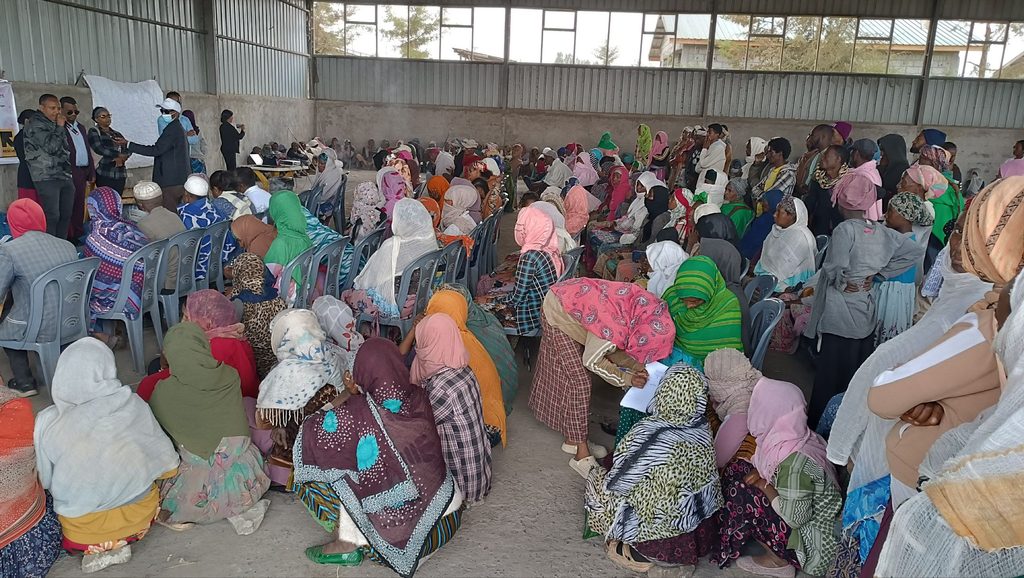
The film was subsequently used in a two-day domestic violence prevention training programme held on 15–16 May, reaching more than 200 parents and teachers in Yirgalem and Aleta-Wondo towns in Ethiopia’s Sidama National Regional State. In May 2026, IHO organised a further community screening and awareness session in Yirgalem Town, engaging an additional 70 women in discussions on domestic violence, gender equality, women’s rights and community responsibility.
Beyond these community activities, IHO also integrated Tidar into humanitarian programming. In March 2026, the organisation facilitated a screening for more than 700 internally displaced persons (IDPs) from Oromia living in the China, Bekelo and Woyinshet IDP sites in Debre Berhan Town. The screening was combined with awareness-raising sessions on the prevention of domestic violence and gender-based violence. Following the screening, IHO distributed dignity kits to vulnerable women and girls, ensuring that participants received not only information and opportunities for discussion but also practical support to meet immediate needs.
Across these documented activities, Tidar directly reached more than 1,000 community members, creating spaces for dialogue, reflection and learning among women, men, teachers, parents, religious leaders, humanitarian practitioners and internally displaced communities.
Impact through sharing lived experience, reflection and dialogue
The screenings enabled women to reflect on experiences of violence and barriers to seeking support, encouraged many male viewers to examine harmful behaviours and responsibilities within families, supported religious leaders and community influencers to (re)consider their role in preventing violence and enabled service providers and institutions to reflect on strengthening responses.
Many expressed frustration that violence against women continued within their communities, while some women shared personal experiences of abuse and divorce linked to domestic violence. During subsequent screenings, IHO facilitators observed continued reflection and subsequent attitudinal changes. Female participants described feeling encouraged by the actions of the main character, while some male participants acknowledged behaviours they recognised in themselves and reflected on the need for change. Participants called for further screenings, describing Tidar as an important awareness tool and a “wake-up call” for communities.
The screenings also demonstrated the importance of culturally sensitive facilitation and pointed to opportunities for further contextualisation to Ethiopia’ diverse religious and cultural communities. During the IDP screening in Debre Berhan, some participants from the Muslim community expressed suspicion that the film might seek to promote the Christian faith as it portrayed the story of a Christian Orthodox victim, reflecting the original research context. Following respectful clarification that the film’s purpose was to raise awareness about domestic violence with this faith community as a starting point, rather than promote any religion, many Muslim participants actively engaged in the discussion. It is notable that the original aim of Project dldl was to replicate the research in Muslim communities of Ethiopia and develop a similar film, but this was not materialised due to the war that unfolded in 2020-2022.
The participants’ feedback highlighted both the universal relevance of the film’s message and the importance of sufficiently and properly contextualising awareness-raising resources to maximise participation across diverse religious communities. IHO and IDVRM are also currently exploring further funding opportunities to adapt the film to Muslim communities of Ethiopia.
Cultural value
Tidar demonstrates how creative works can generate lasting cultural value by transforming research into an accessible resource that communities can interpret, adapt and use according to their own priorities. Through IHO’s engagement, a film developed through Ethiopian and UK collaboration became a locally owned tool for dialogue and mobilisation around domestic violence prevention in both community development and humanitarian settings.
The film has supported conversations on social norms, gender roles and collective responsibility while creating opportunities for women, men, religious leaders, teachers, service providers and humanitarian actors to reflect on their roles in preventing violence. Its continued adoption by IHO illustrates how culturally grounded storytelling can bridge academic research, creative practice and community action, generating new knowledge through implementation while strengthening locally led pathways towards social change.
Partner testimonials
I sincerely appreciate the effort you and your team have invested in documenting this important work. Thank you for recognising IHO Ethiopia’s contribution and for your continued partnership. It has been a privilege to use Tidar as a community engagement and awareness-raising tool. We look forward to continuing our collaboration to promote the prevention of domestic violence and strengthen community-led social change across Ethiopia.
―Tsehaynew Ademe, Founder and Executive Director of IHO
The educational drama produced by the institute in three different languages has been an absolute game-changer, breaking down complex societal stigmas and starting vital conversations across diverse cultural divides. This creative outreach is seamlessly backed by essential religious support and teaching, which meets people exactly where they are, allowing faith to become a source of comfort rather than a barrier to safety.
―Dr Haile Gezae, Tigrigna Expert and Project dldl collaborator
Credits: This case study was developed on the basis of regular reports submitted to IDVRM voluntarily by IHO. Images have been provided by IHO and were taken with participants’ consent.