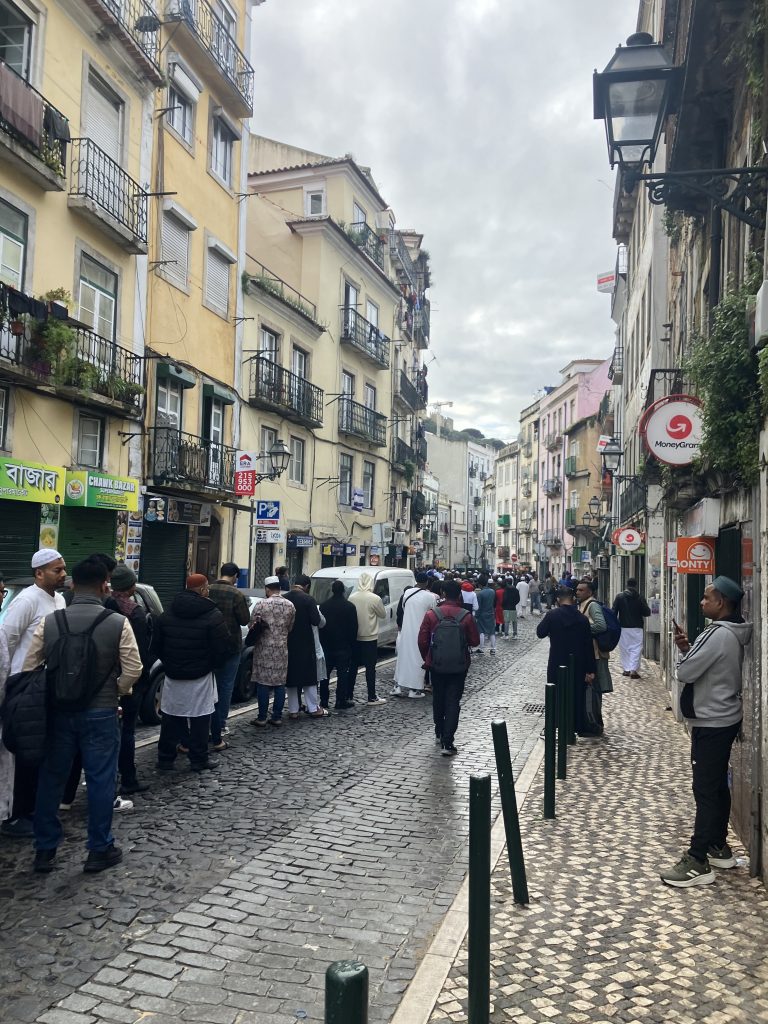
Photo Credits: Rua do Benformoso, Martim Moniz, 20 March 2026. © Constança Nunes.
In this blog, Constança Nunes reflects on how discourses of tolerance shape migration narratives in Martim Moniz, a multicultural neighbourhood in Lisbon, Portugal. The blog examines an emerging migration narrative that appears to be grounded in the principle of tolerance. Nunes suggests that, when presented as neutral and universal, ‘tolerance’ discourages critical scrutiny, leaving the tensions it generates with other value systems in multicultural settings unexplored. As a result, it can perpetuate inequality rather than address it. Nunes concludes that only by recognising the liberal roots of ‘tolerance’ and scrutinising its underlying assumptions can we work towards a more inclusive society that substantively engages with cultural and religious difference.
I check my watch as I approach Martim Moniz Square: it is 20 March, 7:52 a.m. The square is nearly empty, with only a few people passing through. This scene stands in stark contrast to last year’s Eid al–Fitr (“Festival of Breaking Fast”)[1], when, at this same hour, thousands of Muslim men filled the square for collective prayer.
As I walk through the surrounding streets, I notice hundreds—perhaps thousands—of men lined up along the sidewalks, waiting for their turn to enter the local mosque. The scale of participation appears comparable to that of the previous year’s celebration, but its spatial expression has shifted.
These changes in spatial arrangements suggest that the Muslim community of Martim Moniz has chosen to celebrate Eid al-Fitr differently this year: not in the square, nor through a highly visible public display of faith, but rather through a more dispersed and less conspicuous form of gathering.
Martim Moniz as a Backdrop to Migration Narratives
Martim Moniz has become a flashpoint for broader debates over migration in Portugal. Historically a low-income neighbourhood, it is now a popular settlement area for migrant communities, particularly Muslim communities from Bangladesh, India and Nepal (Fernandes, 2023). Its streets are filled with small businesses serving its residents, in contrast to the gentrified areas surrounding the neighbourhood (Fernandes, 2023). Although Muslims constitute a minority among migrants in Portugal (Teixeira, et al., 2019), migration debates often focus on a recurring visual representation: young, low-paid Muslim men gathering in groups or wandering alone at all hours (CRIA, 2025). This image is often associated with fears of delinquency and insecurity.
The 2025 Eid al–Fitr celebration, when around 5,000 Muslim men gathered in Martim Moniz Square to pray, sparked a heated national discussion on migration. Positions ranged from strong anti-migration sentiment to more open approaches. A discourse advocating humane, rules-based migration policies and presenting itself as a moderate, responsible approach gained traction, earning broad public approval and support across the political spectrum.
While exploring the intersection of religion and migration in Portuguese society, I was struck by this emerging narrative. Framed as capable of reconciling competing positions on the issue, promising both openness and a sense of control, and met with rapid, largely uncritical acceptance, it raised several questions for me: can the complex challenges posed by migration be disentangled by a discourse that promises to please all sides? Or does its appeal mask deeper complexities? If so, what are they?
How this Emerging Narrative on Migration has been Framed
This new narrative appears to be grounded in the principle of tolerance. As codified in the 1995 UNESCO Declaration of Principles on Tolerance, tolerance requires respect for human rights and diversity and is framed as central to multicultural justice. Portugal’s adherence to international law, combined with its self-image as a historically open and welcoming society, makes the commitment to tolerance particularly compelling.
Its proponents foreground ‘tolerance’ on openness while simultaneously underscoring the need to impose limits on migration. Advocates argue that aligning migration with the country’s capacity for integration is essential to ensuring a humane migration policy: by setting limits on migration, they contend, migrants can be guaranteed access to fundamental rights, such as employment and adequate housing. Falling to provide migrant communities with dignified living conditions, by contrast, constitutes a violation of human rights and exposes migrants to risks of exploitation and involvement in trafficking networks. Such conditions have been reported in Martim Moniz, where overcrowded housing and exploitative practices have been documented. From this perspective, a responsible and humanist approach to migration requires regulation to determine who may enter Portugal, how many people may do so, and under what conditions they may remain.
Framed within a narrative of ‘tolerance’ and limited primarily by the need to protect migrants’ fundamental rights, I submit that this emerging approach discourages critical scrutiny. I believe that there are more complex dynamics at play worth scrutinising.
Deconstructing the Discourse of ‘Tolerance
In Western liberal societies, ‘tolerance’ is presented as neutral and universal, not serving any group and capable of promoting equal citizenship, since cultural and religious differences are assumed to belong to the private sphere (Brown, 2006; Taylor, 1994). As a result, ‘tolerance’ is seen as “depoliticised,” making scrutiny of the political agendas that shape its deployment appear unnecessary or even trivial (Brown, 2006).
However, ‘tolerance’ is neither impartial nor universal (Brown, 2006; Earle, 2015; and Taylor, 1994). The notion demonstrably emerged in early liberal thought, rooted in historically Christian and Western philosophical traditions (Brown, 2006; Taylor, 1994; Modood, 2007). Therefore, ‘tolerance’ is necessarily embedded within the same cultural context from which it arises (Brown 2006; Taylor, 1994).
When a culturally rooted concept is presented as neutral and universal, it conceals the tensions it generates with other value systems in multicultural settings (Modood, 2007). Emerging from a Western epistemology, ‘tolerance’ presumes a ‘foreign’—that is, non-Western—subject whose presence must be integrated into and regulated by the ‘tolerant’ (Western) community. In this sense, ‘tolerance’ functions to determine how much difference the ‘tolerating’ group can absorb without compromising its own identity (Brown, 2006). Yet, no matter how fully the ‘foreign’ or ‘tolerated’ subject is integrated, it never entirely becomes part of the ‘tolerant’ community (Brown, 2006).
As a result, the ability of a standard based on ‘tolerance’ to genuinely uphold human rights and respect diversity is undermined. Rather than functioning solely as a principle of inclusion, ‘tolerance’ can operate as a tool of governance that subtly defines who is accepted and who is excluded, reproducing structural inequalities and legitimising dominant cultural norms (Brown, 2006), even when framed as ‘humanism’ and regardless of the genuinely good intentions of its proponents.
This perspective may help to explain why Muslim migrants—and not Christian migrants, who constitute the majority in Portugal (Teixeira, 2019)—are at the centre of migration debates. It also adds nuance to understand better why this proclaimed ‘humanist’ approach emphasises housing and employment as fundamental rights and places stress on widespread portrayals of Muslim migrants as men wandering alone or in groups at night and thereby conveying messages of danger and insecurity. On the other hand, access to healthcare, for instance, remains widely contested. Similarly, claims that restrictive migration policies can protect migrants from trafficking networks, albeit grounded in real instances of exploitation, overlook other evidence that strict migration controls can also perpetuate human trafficking (Lumley-Sapanski & Schwarz, 2024).
In this sense, rather than reflecting a genuine commitment to human rights and diversity, this proclaimed ‘humanist’ narrative mobilises ‘tolerance’ while remaining uncritical of its contributions—intended or unintended—to regulating and containing undesirable migrant communities, including the Muslim community in Martim Moniz. In doing so, it can perpetuate inequality rather than addressing it, reproducing colonial legacies and mentalities.
Agency as a Response to the Discourse of Tolerance
Like many marginalised communities that actively seek to shape how they are represented, the Muslim community in Martim Moniz has not been a passive recipient of the narrative of ‘tolerance.’ The community’s decision to hold the 2026 Eid al-Fitr celebration differently is an example of that. It chose to move the event away from the square and adopt a less prominent form of gathering in response to backlash following the previous year’s celebrations, arguably becoming an active participant in reshaping the terms of its representation and negotiating the boundaries of inclusion and acceptance in Portuguese society.
Concluding remarks
The narratives surrounding Eid al-Fitr in Martim Moniz illustrate how ‘tolerance’, when presented as neutral and universal, can be mobilised as a tool of migration governance. When used to define who belongs and under what terms, notions of tolerance can legitimise inequalities rather than address them. By recognising its liberal roots and scrutinising its deeper assumptions we can understand the limitations of its deployment in public discourse and work towards a more inclusive society that substantively engages with cultural and religious difference.
A note on positionality
As a Portuguese researcher trained in Western academic institutions, my positionality enables a dual approach to the epistemic tradition I examine in this blog essay. My education has equipped me in methodological observation and discourse analysis and has granted me exposure to decolonial literature. At the same time, it has situated me within the very epistemological frameworks I interrogate, limiting my ability to fully eschew the assumptions that underpin them. This positionality allows me to examine how discourses of tolerance operate as a tool of governance, while remaining attentive to potential blind spots in my analysis that may leave other Western (or other cultural) epistemological assumptions unquestioned.
[1] Eid al–Fitr is a major Islamic celebration marking the end of Ramadan, a period of spiritual renewal for Muslims during which they honor the revelation of the Qurʾān through fasting during daylight hours and heightened devotional practices.
References
Brown, W. (2006). Regulating Aversion: Tolerance in the Age of Identity and Empire. Princeton University Press.
Carvalho, P. (2023, July 17). Detidos seis suspeitos de rede ilegal que terá afetado seis mil imigrantes Público. https://www.publico.pt/2023/07/17/sociedade/noticia/megaoperacao-lisboa-desmantelar-rede-imigracao-ilegal-europa-2057098
CRIA―Centro de Rede em Investigação em Antropologia (2025). NaMoura―Na Mouraria: Património, (in)seguranças e imaginários urbanos no centro histórico de Lisboa. CRIA. https://heyzine.com/flip-book/033d00e48b.html#page/2
Earle, C. (2015). Good Muslims, Bad Muslims, and the Nation: The “Ground Zero Mosque” and the Problem with Tolerance. Communication and Critical/Cultural Studies, 12(2), 121–138. https://doi.org/10.1080/14791420.2015.1008529
Fernandes, J. F. (2023). Martim Moniz: Como o Desenhar e Passar a Admirar. Fundação Francisco Manuel dos Santos.
Gil, A. R. (2024, December 29). Imigrantes e SNS – no meio é que está a virtude Diário de Notícias. https://www.dn.pt/opiniao-dn/opiniao/imigrantes-e-sns-no-meio-e-que-esta-a-virtude
Lima, A. (2025, June 7). Islamofobia. “Temos é de esclarecer, criar pontes, eliminar este veneno”, diz investigador Diário de Notícias. https://www.dn.pt/sociedade/islamofobia-temos-%C3%A9-de-esclarecer-criar-pontes-eliminar-este-veneno-diz-investigador
Lumley-Sapanski, A., & Schwarz, K. (2024). The impact of immigration policy on human trafficking and modern slavery University of Nottingham Lab Rights Lab. https://www.nottingham.ac.uk/research/beacons-of-excellence/rights-lab/resources/reports-and-briefings/2024/october/the-impact-of-immigration-policy-on-human-trafficking-and-modern-slavery-the-state-of-evidence.pdf
Lusa (2023, September 21). “Portugal é conhecido pela tolerância, pelo respeito recíproco, pelo diálogo entre religiões” Lusa. https://sicnoticias.pt/pais/2023-09-21-Portugal-e-conhecido-pela-tolerancia-pelo-respeito-reciproco-pelo-dialogo-entre-religioes-5d298820
— (2024, December 20). Two detained in big police operation in immigrant neighbourhood Lusa. https://aman-alliance.org/Home/ContentDetail/84020#
— (2025, March 30). Cinco mil muçulmanos em oração ao nascer do dia celebram fim do Ramadão na Alameda Observador. https://observador.pt/2025/03/30/cinco-mil-muculmanos-em-oracao-ao-nascer-do-dia-celebram-fim-do-ramadao-na-alameda/
―(2025, April 15). Estudo ISCTE conclui que apenas metade dos refugiados e migrantes com condições dignas de habitação Observador. https://observador.pt/2025/04/15/estudo-do-iscte-conclui-que-apenas-metade-dos-refugiados-e-migrantes-com-condicoes-dignas-de-habitacao/
―(2025, April 16). Montenegro afirma que país político covergiu com Governo por uma imigração com regras Diário de Notícias https://www.dn.pt/pol%C3%ADtica/montenegro-afirma-que-pa%C3%ADs-pol%C3%ADtico-convergiu-com-governo-por-uma-imigra%C3%A7%C3%A3o-com-regras
Modood, T. (2007). Multiculturalism: A Civic Idea. Polity Press.
Taylor, C. (1994). The Politics of Recognition. In Taylor, C. (Ed) Multiculturalism: Examining the Politics of Recognition (pp. 25-73). Princeton University Press.
Teixeira, A., Vilaça, H., Moniz, J. B., Coutinho, J. P., Franca, M., & Dix, S. (2019). Identidades religiosas na Área Metropolitana de Lisboa. Fundação Francisco Manuel dos Santos. https://ffms.pt/pt-pt/estudos/estudos/identidades-religiosas-e-dinamica-social-na-area-metropolitana-de-lisboa
XXIV Governo (2025, April 1). Governo prosseguirá política de imigração controlada. República Portuguesa, XXIV Governo. https://www.portugal.gov.pt/pt/gc24/comunicacao/noticia?i=governo-prosseguira-politica-de-imigracao-controlada

Constança Nunes is a Research Associate at IDVRM. She holds an LLM from QMUL and an MA in Religion, Politics, and Society from SOAS. Her research ranges from examining the challenges of multiculturalism in Western legal systems to unveiling the complex meanings embedded in emerging popular cultural practices, offering insights into evolving forms of self and social connection. She has professional experience in community development, cultural protection, and social innovation in Europe and Africa. Her work includes providing strategic consultancy to foundations and NGOs as well as leading the development of evidence-based publications to inform public policy. Currently, her research focuses on the intersection of religion, materiality and gender, with particular attention to emerging spiritualities. She is especially interested in how perceptions of self, belonging, and place-making are constructed in increasingly multicultural settings. Constança can be reached at: constanca.cfnunes@gmail.com
Disclaimer: IDVRM aims to serve as a platform that researchers internationally, especially in the non-western world, can use to disseminate their research. We do our best to ensure that authors who publish with us have conducted their research following the highest ethical standards, with decolonial reflexivity and principles of least harm to participants in mind. We do not require authors to submit ethical documentation, but we ask our authors to provide sufficient information about ethical procedures in their submissions. It is beyond the capacity of IDVRM to verify this information. Authors should be reached directly to respond to questions regarding their research.
Opinions expressed by authors contributing to our blog are those solely of the authors and do not necessarily represent the position of IDVRM, its Director or other team members. IDVRM is comprised of diverse individuals who are encouraged to share their experiences and opinions openly with recognition that other team members may have different experiences and positions. IDVRM does not claim to represent any one community and we understand that belonging to a specific group does not entitle any one of us to speak for all.
AI Use: IDVRM may use AI tools for editing and proofreading purposes to improve language, syntax and grammar. Essays must be the original work of the author.