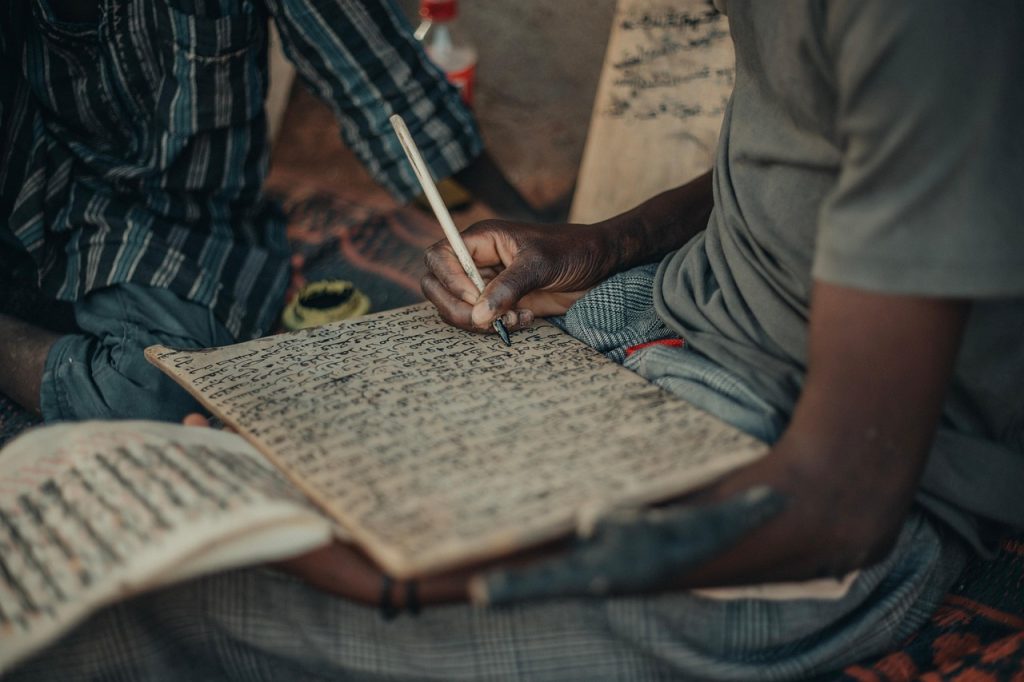
Source: Pixabay
In this blog essay, Chukwudera Nwodo explores his personal and intellectual journey of cultural and linguistic reclamation as an Igbo diasporic African living in the digital age. Chukwudera situates Igbo language endangerment within broader colonial histories and the sociopolitical forces that encourage Africans to favour Western norms for mobility and prestige, contributing to a fragmented identity. He then examines how digital technologies and social media offer new spaces for the revitalisation of Igbo Indigenous religion, cosmologies, and cultural narratives, enabling diasporic communities to re-engage with their traditions. Ultimately, the essay argues that reclaiming the Igbo language, spiritual practices, and cultural frameworks is essential not merely for preservation, but for sustaining distinct epistemologies and ways of being that affirm Igbo humanity in the 21st century.
“Igbo-speaking opens you up to a new way of seeing the world”
Chimamanda Ngozi Adichie (2018)
Yearning For Nne and Nna’s World
As a child, seated with my young siblings in our family apartment on a hot Sunday evening, Mommy (Nne) and Daddy (Nna) were on their weekly call with our grandfather (Nna Nna). Listening closely amid the loud TV noise, with CNN on, I heard them speaking Igbo—our language, familiar and foreign to my siblings and me. Before ending each call, my parents would pass the phone to me on speaker as the firstborn son (diokpala) to speak to Nna Nna, who would often say, “Kedu ka ị mere?”—”How are you?”—with the usual response of “Ọ dị mma” (I am fine). Nna Nna would then speak to me in long, complex Igbo sentences, with my parents watching me. I nodded and agreed with him by saying “yes, Papa”, as if I understood everything in our phone conversations. On subsequent occasions, I noticed that my parents’ facial expressions were more genuine when they spoke Igbo. And I yearned to be immersed in their world. Over time, this linguistic displacement grew, and most of my responses were in English alone—a rage soon brewed within me. The shame of not understanding my late Nna Nna’s proverbs, the frustration of missing cultural nuances in family conversations, and the sense of being ethnically Igbo, only by my name, yet linguistically dispossessed, shaped my fragmented identity and crisis of belonging.
Glocalised Colonial Pathologisation of the Igbo Language
Unlike many other tribes in Nigeria, the Igbos are well known for their industriousness, stubbornness, entrepreneurial spirit, and commitment to the Christian faith (Igwe, Ochinanwata, & Emeordi, 2025; Anyanwu, 2019). Spanning across Southeastern Nigeria, the Igbo people are known for birthing one of the greatest literary minds, such as Chinua Achebe, Chimamanda Adichie, and Adaobi Nwaubani, who have also alluded to the gradual decline of the Igbo language and culture in modern Igbo societies. Studies have shown that the Igbo language has steadily declined, particularly because many Igbo parents do not speak it to their children at home, due to several factors (Odionye, 2024; Bob & Kwekowe, 2023; Umunnakwe, 2015). One factor is the impact of globalisation. Under the pressures of Western modernisation, it has impacted global communication and the importation of Western socio-economic collaboration, leading to a shift in cultural values within Africa. Globalisation encompasses the widespread accessibility to global Western media, digital technologies, images, ideas, and lifestyles that young Africans readily consume and use to achieve upward social mobility (Odionye, 2024; Kiamu & Musa, 2021).
Historical Roots of Igbo Language Endangerment
While globalisation presents itself as an emerging, interconnected, interdependent and vibrant process shaping the world, it is also worth noting that its political formation in Africa is tied to the logic of colonialism. It is essential to understand that the endangerment of the Igbo language is tied to the fact that the English language was imposed through systems of violence, particularly the transfer of colonially imported religions. To maintain survival, relevance, and upward mobility in British-colonised Nigerian society, the Igbo people converted to Christianity while striving to learn, emulate, and speak English to align with Western socioeconomic ideals of progress. Eke & Salawu (2025: 78) write:
“The ultimate consequence, therefore, became the paring down of Igbo language in favour of the more useful, the more influential and the more prestigious colonial languages”
These tendencies to capitulate to the pressures of coloniality have resulted in the abandonment of intergenerational transmission of the Igbo language, entering into modern Igbo homes as modern Igbo parents who aspire for educational excellence for their children, both within the country and beyond, espouse the use of colonial languages like English when speaking to their children rather than the Igbo language (Umunnakwe, 2015).
Little do they know that an Igbo child, not knowing Igbo in both worlds—in this case, the home and the outside world—later in their life feels frustrated and suffers a crisis of a concretised, alienated identity with a disembodied African sense of self and a Westernised sense of self while being phenotypically African—Black. Ngugi wa Thiong’o warned us about this in his 1986 work, Decolonising the Mind: The Politics of Language in African Literature. Similarly, in decolonising African religious-philosophies, Ghanaian Decolonial Philosopher Kwasi Wiredu (1998) posited that without knowing African Indigenous languages in the African Indigenous lexicon, it would be challenging to decolonise the colonial conceptions that viewed Africa as a vilified, dehumanised, futile monolithic entity that lacks originality, rather than illuminating the plurality of African thought and ways of life. Therefore, devaluation of the Igbo language reinforces the claim that the Igbos—Africans—do not know who or what they are, and that African—Igbo history and identity only began with colonialism and the advent of Western Christianity.
Ilo Ụwa—Digitised Reincarnated Narrations:
Young Igbo people, in their attempt to reconcile the complex cultural beliefs with Igbo and Christian eschatological worldviews of life, utilise social media to explore their cosmological roots. Digital platforms such as YouTube, Facebook, TikTok and Instagram “have become popular spaces where youth share personal stories of reincarnation, blending traditional explanatory frameworks with modern scepticism or reinterpretation” (Mbalisi et al., 2025). Udenze (2022) writes:
“Platforms like Twitter, where hashtags such as #Igbotwitter thrive with helpful translation tools, provide spaces for collective storytelling and cultural discourse”
The Igbo still believe in reincarnation—Ilo Ụwa—in which one is reborn into a family to fulfil their life cycle holistically. This belief still carries weight in many Igbo households despite most Igbos’ claims of being Christian in rejecting tradition. Digital platforms, with their ability to adapt, have enabled the revitalisation of Igbo cultural and spiritual heritage. Young Igbo continually strive to understand their Igbo identity via socially mediated spaces. Such adapted technological wiring(s) from and through Igbo tradition, like many African beliefs, still reaffirm the notion of reincarnation, which maintains African cosmological beliefs in timelessness, ancestral return, and the cyclical existence of being and morality.
A Resolute Diasporic Igbo Being in the Modern Digital Era
Being an avid reader and history enthusiast in my formative years, I endeavoured to find myself through extensive reading of books by prominent Nigerian—Igbo scholars. By reading books like Things Fall Apart by Chinua Achebe (1958) and The Joys of Motherhood by Buchi Emecheta (1979), I was immersed in the imagined pre-colonial times of Igboland and the colonial violence that affected pre-colonial Igbo ways of life. There were characters in such books that spoke to themes of reincarnation. On YouTube, I also began researching the history and beliefs of Igbo Indigenous religion and spiritualities such as Ọdịnanị, including its culture and society. I then remembered why my father always said I looked and behaved like his father, Nna Nna, in his paternal Igbo hometown of Amurri. Within my storied identity, I negotiated between the hidden Indigenous belief embedded in my cultural DNA, conflicting with my colonised Christianised African. Indeed, unbeknownst to me, my dual identity was sparked by a decolonial-infused rage of awakening.
The reclamation of the Igbo language is not merely a nostalgic preservation project—it is fundamentally about sustaining distinct ways of being, knowing, and relating to the Igbo world, its logics and sociocultural frameworks. Digital preservation efforts are just not peripheral concerns but existential imperatives. The survival of the Igbo language is inseparable from the survival of the Igbo people themselves as a distinct cultural community with their own valid and valuable ways of constructing meaning and inhabiting the world. To reclaim the Igbo language, Indigenous religion, and culture is to reclaim the Igbos’ full humanity, their ancestral wisdom, and rightful place in the global plurality and human possibilities of the world.
References
Adichie, C. N. (2018, May 2). Igbo bụ Igbo. Keynote Speaker: 7th Annual International Igbo Conference (Memory, Culture and Community). London, United Kingdom: SAOS University of London. Retrieved from https://youtu.be/OY7aDPT6afQ?si=5ojexVCpf4CmAu6q
Anyanwu, C. (2019). Igbo People in Diaspora and the survival of the Igbo Nation: Insights from Igbo Students Association, Delta State University, Abraka (Onye biara ije ga-ala). Journal of African Films & Diaspora Studies, 2(2), 9-24.
Bob, P., & Kwekowe, P. (2023). The Impact of Globalization on the Igbo Language: A Myth or Reality? Evangel University International Journal of Arts and Social Sciences (EUIJASS), 1-5.
Eke, I. W., & Salawu, A. (2025). Exploring the role of digital media in the intergenerational transmission of the Igbo language. South African Journal of African Languages, 45(1), 77-87.
Igwe, P. A., Ochinanwata, C., & Emeordi, R. (2025). Religion and spiritual influence on Igbo entrepreneurial behaviour and persistence. Journal of Small Business & Entrepreneurship, 37(1), 62-85.
Kiamu, B. N., & Musa, B. (2021). Theorizing the Communication of Digital Religion as Popular Culture in Africa: The Case for Alternative Epistemological Models. Howard Journal of Communications, 32(2), 139-155.
Mbalisi, C., Mbalisi, C., & Nwaiwu, N. (2025). Wired Traditions: Influence of Technology on Narratives in Digital Igbo-African Culture in Historical Perspective. Kenneth Dike Journal of African Studies, 4(1), 73-92.
Odionye, C. M. (2024). Effects of Globalization and Modernization on Igbo Language, Communication and Culture. Annals of Language and Literature, 8(2), 1-8.
Umunnakwe, N. (2015). Displacement of indigenous languages in families: A case study of some selected Nigerian families in Botswana. Marang: Journal of Language and Literature, 26(1), 55-76.
Wiredu, K. (1998). Toward Decolonizing African Philosophy and Religion. African Studies Quarterly, 1(4), 17-46.
About the Author
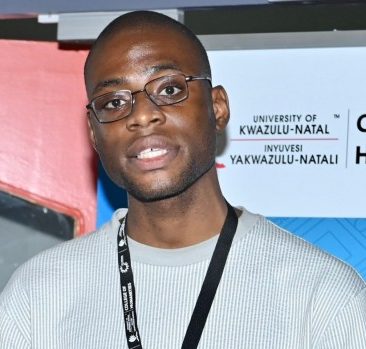
Chukwudera Nwodo is a second-generation Nigerian immigrant, born in South Africa. An African decolonial scholar whose work focuses on the intersectional ties of digital religion, the sociology of gender, sexuality, migration and identity politics. His conference presentations address empowering marginalised voices, identities, including lived Nigerian diasporic experiences, and fighting Indigenous epistemic injustices in Africa. Nwodo is a Religious Studies graduate from the University of KwaZulu-Natal (UKZN) and is currently a Master’s in Religion and Theology candidate at the University of the Western Cape (UWC). Chukwudera can be reached at: Chukwuderanwodo20@gmail.com
Disclaimer: IDVRM aims to serve as a platform that researchers internationally, especially in the non-western world, can use to disseminate their research. We do our best to ensure that authors who publish with us have conducted their research following the highest ethical standards, with decolonial reflexivity and principles of least harm to participants in mind. We do not require authors to submit ethical documentation, but we ask our authors to provide sufficient information about ethical procedures in their submissions. It is beyond the capacity of IDVRM to verify this information. Authors should be reached directly to respond to questions regarding their research.
Opinions expressed by authors contributing to our blog are those solely of the authors and do not necessarily represent the position of IDVRM, its Director or other team members. IDVRM is comprised of diverse individuals who are encouraged to share their experiences and opinions openly with recognition that other team members may have different experiences and positions. IDVRM does not claim to represent any one community and we understand that belonging to a specific group does not entitle any one of us to speak for all.
AI Use: IDVRM may use AI tools for editing and proofreading purposes to improve language, syntax and grammar. Essays must be the original work of the author.